Saturday, October 14, 2017

Stigma

October 15th, 2017

In the midst of prepping and procrastinating for my final anatomy lab practical and exam this week, I did some reading about Self Determination Theory. (I only took one psychology class in college, and I wish that I had taken plenty more - coupled with so many other classes I wish I had pursued, including but certainly not limited to philosophy, anthropology, sociology, linguistics, engineering, and more). 

I digress. Tangents seem to be the norm for me when I am writing and I try to contain myself when I am writing on here, as best I can.

Self Determination Theory (SDT) is a behavioral theory that posits three basic conditions related to an individual's motivation engagement, and creativity: 1) Autonomy; 2) Competence; and 3) Relatedness.

Autonomy refers to such feelings as freedom, independence, self-governance, and choice. Competence describes feelings of mastery. And relatedness is characterized by feelings of connection and engagement with others. 

According to SDT, the greater the degree to which these three conditions are evoked, the high the chance a person will have of successfully and effectively implementing and maintaining behavioral change. 

As I started to read about how this theory is applied in the context of health behaviors specifically (such as exercising, decreasing soda/ sugar consumption, eating more fruits and vegetables, etc.), I was somewhat surprised when I discovered how often the relatedness factor was key to successful behavioral interventions and lasting behavioral change. 

I had assumed that competence - feeling adept and confident in one's own sills or knowledge - would be the prime driver of successful change. Yet study after study revealed that it is exceedingly challenging for individuals to change or sustain health-related behaviors without the presence of social support. 

The more I considered this, the more I realize how much this finding aligns with what I've observed around me as well as my own experience. Since med school started, I've struggled with making friends and meeting people. It seems like everyone has already solidified their friend groups and the gates have closed to latecomers, such as myself. Whether this is merely my perception or reality, I've found myself feeling isolated yet longing for connection and camaraderie. 

In the words of psychologist Brene Brown, "Connection, the ability to feel connected, is neurobiologically wired, that's why we're here."

In this time of transition to a new Block, I want to take the time to be more intentional about cultivating connection and nurturing relationships in my life. I also want to remember that social support doesn't always come from family and friends - it can take form in online communities, local/ community organizations, or in clubs and gatherings. 

Regardless of where it comes from, however, I believe that feeling connected inspires a sense of belonging that eases the challenging work of navigating the changes that are inevitable in all of our lives and in navigating the changes we would like to consciously implement.

I was contemplating the importance of a building a supportive, welcoming, and inclusive community as I read this article about the impact that culture has on the experience of mental illnesses. The article notes that individuals who experience schizophrenia in cultures with less stigma against and isolation of people with mental illnesses tend to have better prognoses. For all of our research and innovation, individuals with mental illness in Western culture are worse off in many ways because of the way we medicalized and problematized these illnesses in ways that can be deeply alienating for those who have been diagnosed. (The article further discusses "abjection," or the marginalization of people by labeling).  

I believe that lonely or isolated people are frequently pushed even further into their alienation by cultures that do not accommodate and embrace difference. This article made me reflect on the ways in which our treatment of mental health may deeply compromise the sense of relatedness that is so vital to our wellbeing. 

SDT is just one window through which to view these issues, but it speak to me. I am aware that my personal sense of self pays dearly when my feelings of autonomy, competence, and/or relatedness feel undermined or inadequate. In addition to aiding in behavioral change, I believe that enhancing relatedness can also help individuals grow and heal.

All of this is making me consider ways in which I can bring greater awareness of relatedness and its importance into my work as a physician. I will aim to be more intentional to ask patients about their social networks of support, interpersonal resources, and sense of belonging when I am meeting with them. 

And I feel heartened in my intention to keep writing about mental health - both because it helps me and because it is my own, modest contribution to the goal of challenging stigma.


Saturday, September 23, 2017

Drinking From A Firehose

September 23rd, 2017

During my medical school orientation, an oft-quoted quip was, "medical school is like trying to drink out of a firehose." I had no idea how true this would be. I knew medical school would be a lot of work, but I didn't fully appreciate the depth and breadth of it until I found myself submerged in a sea of information without a buoy on day 1. I just had Exam #2 yesterday (the lab practical and written exam) and I am nervous about how I did. I really wanted to be able to enjoy this weekend and rest and recharge (the weather outside is pretty cantankerous in any case), but I find myself caught up in fitful bouts of stress, overwhelm, and anxiety that keep me up at night and (ironically) cause me to procrastinate and waste time and aimlessly angst even more. I know that my lack of science background isn't exactly working in my favor, but I also believe that science not being my forte will not preclude me from being a really good doctor some day (I don't plan on going into research).

So much seems up in the air right now in my life personally, as well, and the more that ambiguity abounds, the more desperately I seek to pin down definite's and certainties that are impossible to identify. As as example, it seems like everyone knows exactly what specialization/ area/ type of medicine they want to go into, but I seem to change my mind all the time and have a lot of interests. My problem is that I can see myself doing a LOT of things and I also know that my perception of what certain specialities do probably isn't very close to the reality, either.

I've taken the UVA Medical Specialties Aptitude Test dozens of times now and my results seem to keep changing (not sure what that says about my consistency as a person? And my indecisiveness?). On a deep gut level, I know that I am meant to be in medical school, yet self-doubt and comparison and waves of low self-confidence keep washing over me. I still haven't figured found my niche - both in terms of how to best study (which has never been a problem in the past) and in terms of friends. It feels like everyone has time management aced and their "friend group" established already. I sort of feel like an outcast and a total misfit.

At the same time, the fabric of my identity as a (good) student seems to be coming apart at the seams and I don't know who I am when I don't define myself by the labels I put on myself (both good and bad). I know that there is a constant "me" beyond all the external circumstances and roles in my life, but it is hard to tap into that person amidst the whirlwind of everything. Given that I tend to conceptualize and "see" things in images and metaphors, I've been trying to remind myself of two things:

1. I am the bowl/ vessel and my life circumstances are merely the substances that the bowl carries within it - these things can come and go and are different at different times, but the bowl itself is a constant that does not change.

2. Similarly, I am like a chessboard and my thoughts, feelings, and emotional states are like the chess pieces fighting it out within me - yet they don't define the board (my Self).

Other than starting on our last Anatomy unit on Monday (Head & Neck), I've got a pretty packed schedule. I hope to stay mindful and PRESENT because in spite of everything, this (medical school), really is a dream come true and I know that it will go by in a blink of an eye. I want to be present to it.

And on that note, here are a couple of medical-related articles that caught my eye this week:

1. A Neurologist On How To Help Someone In Pain


2. New Ways of Assessing the Agony


3. The Most Common Pre-Existing Medical Conditions


4. Does Happiness Really Make You Healthier? It Depends On Where You Live.


5. Therecould soon be a baby-boom among women who thought they’d hit an IVF dead end.


6. A newstudy is changing how scientists think about Alzheimer’s disease


Saturday, September 16, 2017

Wired For Connection And Trust

September 17th, 2017


I've struggled a lot with medical school this week and I've also had a lot of medical appointments/ health issues that are going to require more of my time in the coming weeks. Even though I've felt like a ball of overwhelm and anxiety, I've also felt deeply supported. I reached out to my anatomy professor as well as the Assistant Dean of Student Affairs, and they both took the time to meet with me and reassure/ help me. The Assistant Dean of Student Affairs also connected me with a current MS2 student who struggled with both anatomy and making friends/ fitting in last year. She and I talked over the phone and then met in person (where she also introduced me to her now boyfriend), which was really nice. Finally, I also got to meet with my tutor and will be joining some of the TAs next week for practice/ quizzing in the anatomy lab before our upcoming written exam and lab practical on Friday.

All of this human contact got me thinking about the quote, "No man is an island entire of itself" (John Donne). And how true this is! I believe that as human beings, we are wired for connection. And we are likewise wired for protection. Yet these two needs often find themselves at odds as connection requires vulnerability - putting oneself out there - which can feel pretty unsafe and exposed. Likewise, both connection and protection seem like challenging needs to get met in a world that is rife with ambiguity and unpredictability. 

Perhaps contrary to expectation, I believe that trust is the way in which we can navigate these challenges and get these needs met. Understanding and practicing how to access trust and be trustworthy is an essential piece of a fulfilled life. This involves having a healthy who, what, when, where, and why of trust.

In many ways, trust is like a muscle (sorry - I've got anatomy on the brain!). I'm thinking about instances when trust quivers and trembles or won't activate or give out at the times when we need it the most. Oftentimes trust won't let go even when that's what we're telling it to do. Who, what, when, where, and why we trust is sometimes lacks reason or consciousness or calibration or consistency.

Training trust - just like with exercising most muscles in the body - is not a matter of "more is better." Rather, it necessitates working trust through its entire range - in various contexts with varying levels of resistance. It involves both "repping" and resting. It signifies that trust is not simply a mechanically isolated part of your being, but that it is part of the beautiful, conscious whole of yourself. Ultimately, to integrate and strengthen trust into one's life is to catalyze and move in support and in the direction of trusting at the right moments and in the right measures, at the right dilemmas and dimensions and in the right doses. 

In the words of Golda Meir: "Trust yourself. Create the kind of self that you will be happy to live with all your life."


Sunday, September 10, 2017

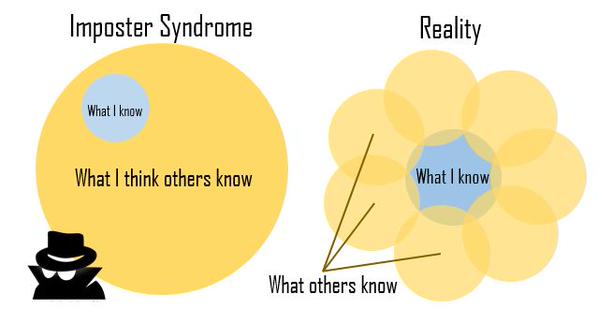
Imposter Syndrome

September 10th, 2017

I had my first written anatomy exam and lab practical this week and I did horribly. I know that they say "compare and despair," but it certainly didn't help knowing that my class average was really high. I've always done well in school and college and in my MBA, and a huge part of my identity and my sense of self has been derived from being a (good) student. The results of my exam are incredibly distressing to me in part because I feel terrified that I won't pass anatomy and in part because they completely challenge my sense of self-worth/ value as a human being.

Friends and mentors and 2nd, 3rd, and 4th year students have all told me that my complete lack of science experience/ background automatically puts me at a disadvantage and that others are also struggling a lot more than they let on, but for some reason hearing those isn't helpful because they are hard to believe. The extent of my struggle feels so monstrously immense and chaotic and overwhelming in nature that it is hard to fathom that anyone else might be in this same sinking ship.

I also think that underlying all of this is my knowing that I didn't try my best (by a far shot). My stress and anxiety levels have been crazy high, leading to my inability to focus/ concentrate. I've likewise let my perfectionism instigate procrastination and distraction. I've lacked discipline in my days and have failed to put in the requisite study time. Plain and simple.

Realistically, I know that "my best" (while maintaining sanity and some balance in my life) probably doesn't equate to getting honors in anatomy, and I wonder whether this all-or-nothing thinking has led me to some major self-sabotage the past few weeks (i.e. "if I'm not going to get honors in anatomy, I might as well just give up and not even try).

Now that we've moved into the next unit, I can see that I've continued to self-sabotage in many ways and I make excuses, when in reality I am a lot more resourceful than I'm allowing myself to be in these circumstances. I'm still worried about (not) passing anatomy, but I want to truly take the time to "reset" this week. I want to take the time to sit down with my professors, my tutor - and myself - and make a proactive plan regarding how to address this. I cannot hide and poke my head in the metaphorical sands of distraction and self-loathing and overwhelm and expect these issues to go away. I must face them head on, even if doing so requires the acceptance that one's best doesn't always (or even often) mean perfection.

The reality is that medical school has been my dreams for YEARS and CU was my top choice. I am living a dream come true. I don't want to blow this.